
General Information International FJ
Hull
| LOA | 4.03 m |
| Beam | 1.50 m |
| Draft | 1.05 m |
| Hull weight (min) | 75 kg |
Sails
| Close hauled | 9.7 m2 |
| Main sail | 7.3 m2 |
| Jib | 2.4 m2 |
| Spinnaker | 8.0 m2 |

The International FJ is a doublehanded, ISAF International Class, trapeze planing dinghy. It is small, light and fast, suitable for virtually any combination of skipper and crew, from couples, to parent/child teams, and siblings.
The FJ is very a competitive one-design boat, meeting strict Class Rules. The fact that the FJ is a one-design means that the boats are raced boat for boat, without handicapping. The light weight of the boat, combined with the trapeze as a hiking aid, means that a small crew can sail the FJ very effectively, and the relatively small size of the spinnaker is ideally suited to less-experienced or younger crews as well.
Many one-designs are “builder’s classes”, meaning that the builder controls the boat, and has the sole right to build and sell that particular Class. This means the boats usually qualify to be legal in the Class simply by being made by that builder. In fact, as the tooling or molds wear out, later hulls are different than the originals– are they faster, or slower?? Who knows? It is a less precise way to ensure compliance with Class Rules.
The International FJ, on the other hand, can be built by any yard, or even a private builder. Each boat is “Measured” after building, thus ensuring boats built closer to the original design. The boats are not “FJs” until this Measurement process is complete.
International FJs are also an “International Class”; this is a prestigious designation given to sailing classes that are sailed around the World, in a minimum of six countries on three continents. The International FJ has active racing organizations in- Europe- Holland, Germany, Austria, Italy, Asia- Japan, as well as in North America, the United States. The international nature of the Class means that you can compete at any level– local, Regional, National, Continental, or the bi-annual World Championship.
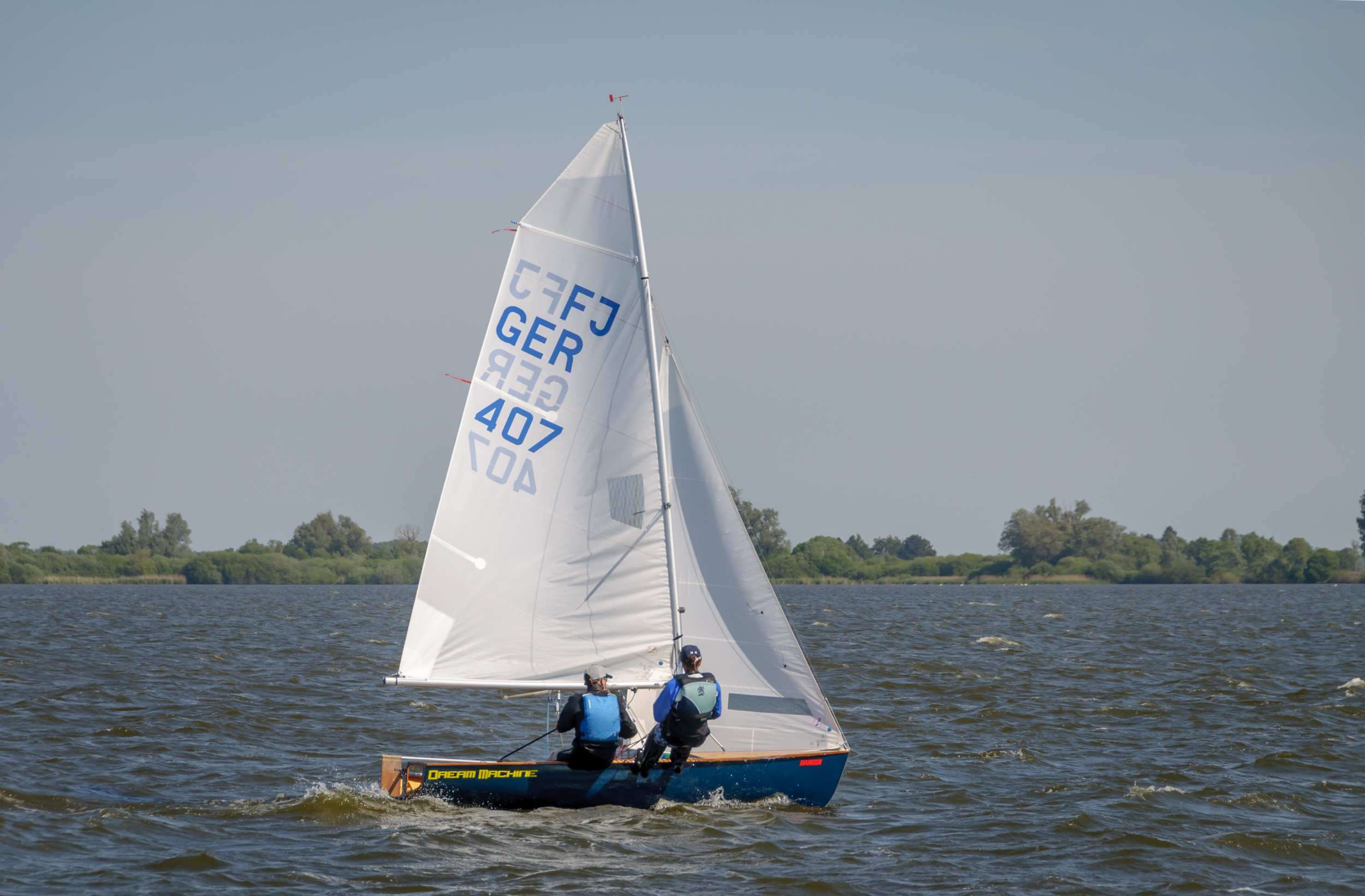
FJ Features:
Easy to sail in a wide variety of wind and sea conditions.
Easy to own- light for trailering, easy maintenance
Fast and exiting to sail- planes in about 12 knots of wind.
Inexpensive- used race-ready FJs are about $2500, new ones are about $5300.
Has a full complement of rigging- main, jib, and spinnaker- the crew always has something to do!!
Excellent design to learn the technical aspects of sailing- the wide range of rigging options allow the FJ to be tuned for any wind condition.
Very competitive racing class- Local, Regional, National and World Championship Regattas available.
Tactical- teaches the important tactical and strategic aspects of racing.
A good daysailor- while designed for two-handed racing, the FJ can carry up to 600 lbs./ 4 people and still perform well.
History
The “Flying Dutchman Junior” was originally designed, in Holland, by Van Essen, a wellknown Dutch boat designer. Listed as codesigner was Conrad Gulcher, Dutch Olympic sailor. (Gulcher and Van Essen also collaborated on the Flying Dutchman Conrad Gulcher served as International Class Secretary for both classes for many years, and was a main driving force behind both the International Flying Dutchman, and International (FJ) Flying Junior classes until his death in 1989.
The first FJ was built of coldmolded wood, and was tested on the water in December, 1955.
The original purpose of the “Flying Dutchman Junior” was to serve as a junior trainer for the then new Olympic Flying Dutchman (FD). The FD is a much larger( 19’10”), faster, and more physical class than its younger sister. The FJ rules also allowed (and still allow) many of the same technical innovations as the FD, and the boat was (and still is) ideal to teach newer sailors the intricacies of tuning, mast rake and bend, etc. so important to top-level competitive sailing.
The Class’ name was quickly changed to “Flying Junior” as the class developed on its own, and the Flying Junior Class Organisation was free and independent of the Flying Dutchman organisation by about 1960.
FJ Gets IYRU International Class Status
By the early 1970’s, the Flying Junior was accorded the status of an International Class by the International Yacht Racing Union (IYRU), predecessor of today’s World Sailing.
This prestigious status is applied only to sailing classes with strict one-design rules, sailed worldwide and regularly hosting international competitions such as World and Continental Championships.
Today, the International FJ is sailed in Japan, Germany, Italy, Belgium, The Netherlands and the USA.
The Class Rules of the FJ allow any deck design; Dusseldorp FJs utilised a double-bottom design, especially suited to open-water sailing. Note the open transom, allowing large amounts of water to escape almost as fast as it can enter the hull. These hulls were the fastest FJs for at least the first 15 years of the Class’ existence and are still competitive today.
From the beginning, the Class Rules allowed any individual or company to build the boat.
Early in the 1960’s, the Class Rules were modified to lengthen the mast, providing more speed and greater clearance under the boom.
Since 1972, FJs have carried the official “Builder Fee Paid” metal plaque permanently affixed in the cockpit, signifying that the builder royalty has been paid. These fees remain the only source of income for the International Class.
In 1980, recognizing that the name “Junior” no longer reflected the way the boat was being sailed, the International Class adopted the name “International FJ”. During the 1980’s, a larger spinnaker and new sail-cutting rules significantly improved downwind performance.
In 1990, the trapeze was introduced for the crew (added to the U.S. class in 1994). Officially, the crew must be at least 12 years of age to use the trapeze.